Your tabs are full. One page shows a hotel with two beds. Another shows a resort with a lazy river. A third promises a “timeshare rental” near Disney, but the listing reads like a puzzle. Is it a regular condo rental, an owner’s unused week, or a sales funnel with a room attached?
That confusion is normal.
Orlando pulls in a huge wave of travelers every year, and the city welcomed over 75 million visitors in 2024 according to this Orlando vacation rental market overview. More visitors means more pressure on every lodging category, not just hotels. Families end up sorting through resorts, villas, condos, hotel suites, and a long list of timeshares rentals in Orlando that can look identical until you read the fine print.
The hard part is not finding an option. The hard part is knowing what you are booking.
A timeshare rental can work for some trips. It can also lock you into awkward dates, inconsistent unit assignments, and fees that only become obvious after you have already committed. For families trying to balance park days, groceries, naps, grandparents, strollers, and budgets, those details matter more than the glossy pool photos.
That is where local judgment helps. Orlando lodging is not one market. It is a patchwork of resort communities, owner-managed inventory, direct-booking sites, and major platforms. If you are comparing options near the parks, this guide on vacation rentals near Disney World is also useful alongside what you will read below.
Your Orlando Vacation Dream and The Accommodation Puzzle
The Orlando trip usually starts with a simple goal. Get close to the parks, keep everyone comfortable, and avoid blowing the budget before the first lightning lane or character meal.
Then the lodging search gets messy.
A family of five may need separate sleeping space, a kitchen, and a pool day built into the trip. A grandparent may want an elevator or a first-floor setup. Parents may care less about a resort lobby and more about laundry, parking, and whether bedtime can happen in one room while someone else watches a movie in another.

Why the choice feels harder than it should
Hotels are familiar. You know what a hotel room is.
Timeshare rentals sit in the middle ground. They often look like vacation condos, and many are in polished resort settings with pools, splash areas, and on-site amenities. On the surface, that sounds like the perfect compromise between a hotel and a house.
The catch is that timeshare rentals are not always as straightforward as standard vacation rentals. The listing may reflect a specific owner’s week, a points-based reservation, or an exchange booking. The photos may show the resort generally rather than the exact unit you will stay in.
That is why travelers often feel stuck between two worries:
- Pay too much for too little space: A standard hotel can force everyone into one room and turn downtime into stress.
- Book something confusing: A timeshare rental can sound spacious and practical, but the terms may be rigid.
What families usually need, not just what listings advertise
The right Orlando stay depends less on branding and more on how your trip functions.
A good lodging decision should reduce friction. If the booking creates uncertainty before arrival, it usually creates more stress after check-in.
Most families do better when they compare accommodations around real trip habits:
| Vacation need | Why it matters in Orlando |
|---|---|
| Separate bedrooms | Early bedtimes and mixed age groups are common |
| Kitchen access | Park food adds up quickly, and breakfast at home saves time |
| Easy parking | Many groups split park days with outlet runs or grocery stops |
| Flexible stay length | Not every trip fits a fixed weekly pattern |
| Quiet downtime | Orlando trips are fun, but they are long and tiring |
That is the lens to use for timeshares rentals in Orlando. Not “Does this resort look nice?” but “Will this booking make the trip easier?”
What Exactly Are Timeshare Rentals
A timeshare rental is usually an owner renting out vacation time they control at a resort. It functions similarly to subletting a vacation condo for a specific window, rather than booking a standard unit from a traditional lodging operator.
That distinction matters because renting a timeshare is not the same thing as buying a timeshare. You are not taking on ownership. You are paying to use a stay that someone else already owns or reserved.
The easiest way to understand it
In practical terms, most timeshares rentals in Orlando fall into one of these patterns:
- Fixed-week rental: An owner has the same resort week each year and rents that week out.
- Points-based booking: An owner uses points to reserve dates and then rents that confirmed stay.
- Exchange inventory rental: A stay comes through an exchange network and is then offered to a traveler.
For the renter, the result can look similar. You book a unit at a resort for a set date range. The difference is behind the scenes. A private owner or broker often controls the reservation, not the front desk in the same way as a hotel booking.
Why there are so many in Orlando
Orlando is one of the strongest markets for this category because the city attracts repeat leisure travel, family trips, school-break travel, and longer resort stays. The broader U.S. timeshare industry recorded $10.5 billion in sales volume in 2024, with an average transaction price around $23,160 for new ownership, according to ARDA industry reporting summarized by Resort Trades.
That scale is why you see so much inventory around the theme park corridor. It is not a niche corner of the lodging market. It is a major segment with well-known brands, owner networks, exchange programs, and rental marketplaces.
What you usually get with a timeshare rental
A typical Orlando timeshare rental often includes:
- More room than a hotel: One-bedroom and two-bedroom layouts are common.
- Residential features: Kitchens, dining space, living rooms, and laundry access are often part of the appeal.
- Resort setting: Pools, activity areas, fitness rooms, and kid-focused amenities are common selling points.
That is the draw. A family sees the layout and thinks, “This feels easier than two hotel rooms.”
Later in the search, a short video overview can help clarify how these resort-style stays differ from standard lodging:
What a timeshare rental is not
It is not always fully flexible.
It is not always the exact room in the photo.
It is not always ideal for a short, loose itinerary where you may want a custom check-in pattern, pet flexibility, or the privacy of a standalone home.
That is where many travelers get tripped up. They see the space and amenities, but they do not see the booking structure until later.
If the listing language focuses heavily on the resort and lightly on the unit, ask more questions. The resort may be fixed, but the exact stay details may not be.
Pros and Cons of Renting a Timeshare
Timeshare rentals can work. They stay popular for a reason.
But they work best when your trip lines up with the product. If your dates are firm, your group likes shared resort amenities, and you are comfortable with a little less control over unit specifics, a timeshare rental may be a solid fit.
If your vacation depends on flexibility, exact home features, or a short stay built around your family’s rhythm, the trade-offs start to show.
Where timeshare rentals do well
The main upside is space inside a resort setting.
Many Orlando timeshare properties give families more breathing room than a standard hotel room. Separate sleeping areas, a living room, and a kitchen can make a real difference after a long park day. Multi-generational groups often appreciate having room to spread out without booking multiple hotel rooms.
The second advantage is the built-in amenity package.
Resort pools, activity calendars, splash zones, playgrounds, and on-site dining can make non-park days easier. For some families, that structure is a real benefit. The resort becomes part of the trip, not just the place you sleep.
Why availability stays strong
The U.S. vacation timeshare industry reported 76.8% occupancy in 2023, compared with 63.0% for hotels, and average annual maintenance fees were $1,220. That matters to renters because owners often price rentals with those carrying costs in mind, as shown in the ARDA industry report.
In plain terms, owners are often trying to offset their ongoing costs. That can shape both pricing and urgency. A renter may find a fair deal, but the owner’s economics are always part of the background.
The friction points travelers notice later
The downside is not usually one dramatic problem. It is a cluster of smaller restrictions.
Date rigidity
Timeshare rentals often fit fixed blocks better than custom trips. If your family wants a shorter stay, a midweek pattern, or a loose arrival schedule, the inventory can feel awkward fast.
Some listings are best suited to week-long use, not flexible mini-breaks.
Unit uncertainty
This is one of the most common disconnects. Travelers may know the resort name and room type, but not the exact unit location, floor, view, or proximity to the pool.
That uncertainty matters when you are traveling with young kids, mobility concerns, or grandparents who do not want a long walk after fireworks.
Sales-tour pressure
Not every stay includes this issue, but it is common enough that travelers should ask directly. Some resorts make promotional offers or present “owner update” invitations at check-in. For guests who want a clean in-and-out experience, that can feel intrusive.
Fee layering
A timeshare rental can look cheaper at first glance and then become less attractive after checkout fees, resort fees, parking charges, or platform fees are added. If you are also trying to save on meals, transportation, and tickets, every extra line item matters.
For families comparing costs carefully, this resource on how to plan a family vacation on a budget pairs well with any timeshare search.
A simple way to judge the fit
Use this decision table before you book:
| If this sounds like you | A timeshare rental may fit |
|---|---|
| You want a resort first, room second | Yes |
| Your travel dates are fixed | Yes |
| You need custom trip length | Maybe not |
| You want the exact property shown | Maybe not |
| You prefer direct, simple pricing | Often not |
| You want privacy over shared amenities | Usually not |
Timeshare rentals reward travelers who can adapt to the system. Private vacation homes reward travelers who want the stay to adapt to them.
This is the core dividing line.
How to Find and Book Legitimate Timeshare Rentals
The timeshare rental market has legitimate inventory, but it also has enough complexity to punish rushed decisions. The safest approach is to treat the booking like a real estate transaction, not like impulse hotel shopping.
You are not just choosing a resort. You are verifying who controls the reservation, what is included, and what happens if something changes.
Where travelers usually look
Most shoppers start on established resale or rental marketplaces. Names that come up often include RedWeek, SellMyTimeshareNow, and Timeshare Users Group (TUG).
Those sites are useful for comparing resort names, unit types, and date windows. They are less useful if you assume every listing follows the same rules. They do not.
Some travelers also compare owner-run listings with direct local property managers that focus on vacation homes instead of timeshares. That is a different lane, but it helps if your priorities are flexibility, pet access, or a private pool. For travelers in that category, these pet-friendly Florida vacation homes can be more relevant than resort inventory.
Questions to ask before you pay
A good timeshare rental inquiry should feel specific, not casual.
Ask for these details in writing:
Resort and unit type
Confirm the exact resort name, bedroom count, kitchen type, and occupancy rules.Reservation status
Ask whether the stay is already confirmed and whose name is on the reservation.Check-in process
Verify what ID is needed, whether the renter’s name must be added in advance, and whether the front desk has the booking on file.Total cost
Ask for every charge up front. That includes cleaning, parking, resort fees, and any booking or transfer fee.Cancellation terms
Some owner rentals are much stricter than hotel bookings.Unit assignment
Clarify whether you are getting a confirmed unit or only a general room category.
Signs a listing deserves extra caution
Not every bad booking is a scam. Some are just poorly handled.
Still, a few warning signs should slow you down:
- Pressure to pay fast: Especially if the owner says another renter is ready but avoids basic verification.
- Payment by wire or app only: A credit card gives you a layer of protection.
- No written rental agreement: Serious rentals should spell out dates, names, total charges, and refund terms.
- Vague unit details: If the seller cannot explain what is confirmed, do not assume it is.
- Mismatch between resort photos and booking details: Generic resort marketing can hide a weak or incomplete reservation.
If someone can take your money, they can send a rental agreement. If they cannot send one, stop there.
What works better in Orlando
Orlando is heavily seasonal. School breaks, holidays, and event weeks tighten inventory and make rushed decisions more likely. That is when travelers overpay or skip verification.
The better approach is slower and less glamorous:
| Booking step | Why it helps |
|---|---|
| Compare the resort against independent listing descriptions | Confirms the stay is real and consistently described |
| Ask for a guest certificate or reservation proof | Shows the renter can transfer access |
| Pay by credit card | Creates a dispute path if the reservation fails |
| Read resort policies separately | Catches parking, check-in, and occupancy rules |
| Keep every message in writing | Reduces confusion if terms change |
What not to do
Do not book based on pool photos alone.
Do not assume a “Disney area” label means a quick commute.
Do not confuse a polished marketplace profile with a polished reservation process.
Some travelers who start in timeshare marketplaces eventually decide they want a simpler path and book a standard vacation home through a local company. That can include owner-direct sites, regional managers, or inventory platforms. One example is Global Vacation Rentals, which offers direct-booked Orlando-area vacation homes in resort communities and private-home formats. The practical difference is not branding. It is that the booking model is usually clearer.
Popular Orlando Timeshare Resorts and Hidden Gotchas
Certain Orlando resort names show up again and again in timeshare searches. Travelers often compare places like Westgate, Marriott’s Grande Vista, Sheraton Vistana, Wyndham Bonnet Creek, and other large resort communities near the attractions corridor.
These properties are popular because they deliver what many vacationers want on paper. More room than a hotel. Resort amenities. Family-friendly layouts. Familiar brand recognition.
The problem is that many listings stop at the brochure version.
What shoppers notice first
A resort listing usually highlights the easy sell:
- Large pool complexes
- On-site dining or snack bars
- Shuttles or easy park access
- Condo-style floor plans
- Activities for kids
Those are real benefits. They just are not the whole story.
What guests discover after booking
The “gotchas” tend to be operational, not dramatic.
A listing may emphasize the resort but stay vague on building placement. Parking may be less simple than expected. Some stays come with front-desk policies that feel more rigid than a vacation-home check-in. Others involve extra forms, ID matching, or age requirements for the primary guest.
Then there is the issue many families do not think about until they need it.
A major blind spot in timeshare coverage is pet policy. 20% of Florida vacationers travel with pets, and many Orlando timeshare resorts still do not make pet access clear or available, according to this overview of Orlando timeshare lodging and pet policy gaps.
That creates a practical split in the market.
The pet problem is bigger than it looks
Families traveling with dogs often start with timeshare resorts because the units look roomy. Then they hit one of these problems:
- No pets allowed at all
- Policy buried in resort rules, not listing copy
- Unclear breed or size restrictions
- No easy way to filter pet-friendly inventory
- Resort layout that is less convenient for pet routines
For pet owners, that often pushes the search away from timeshares and toward private homes where the rules are clearer from the start.
If you are comparing resort communities and want a more neighborhood-specific view, this look at Windsor Hills Resort helps frame how a resort-style location differs from a timeshare stay.
Resort name does not equal booking clarity
That is the hidden pattern across popular Orlando timeshare resorts.
A recognizable resort can still come with:
| Common issue | Why it matters |
|---|---|
| Unclear exact unit | Hard to plan for mobility or noise preferences |
| Added resort rules | More friction at check-in |
| Sales-pitch exposure | Less privacy in the guest experience |
| Limited stay flexibility | Poor fit for shorter custom trips |
| Weak pet options | Forces some travelers to switch categories entirely |
The takeaway is simple. Popular resort names reduce uncertainty about location and amenities, but they do not remove uncertainty about the booking itself.
A Smarter Alternative The Vacation Rental Advantage
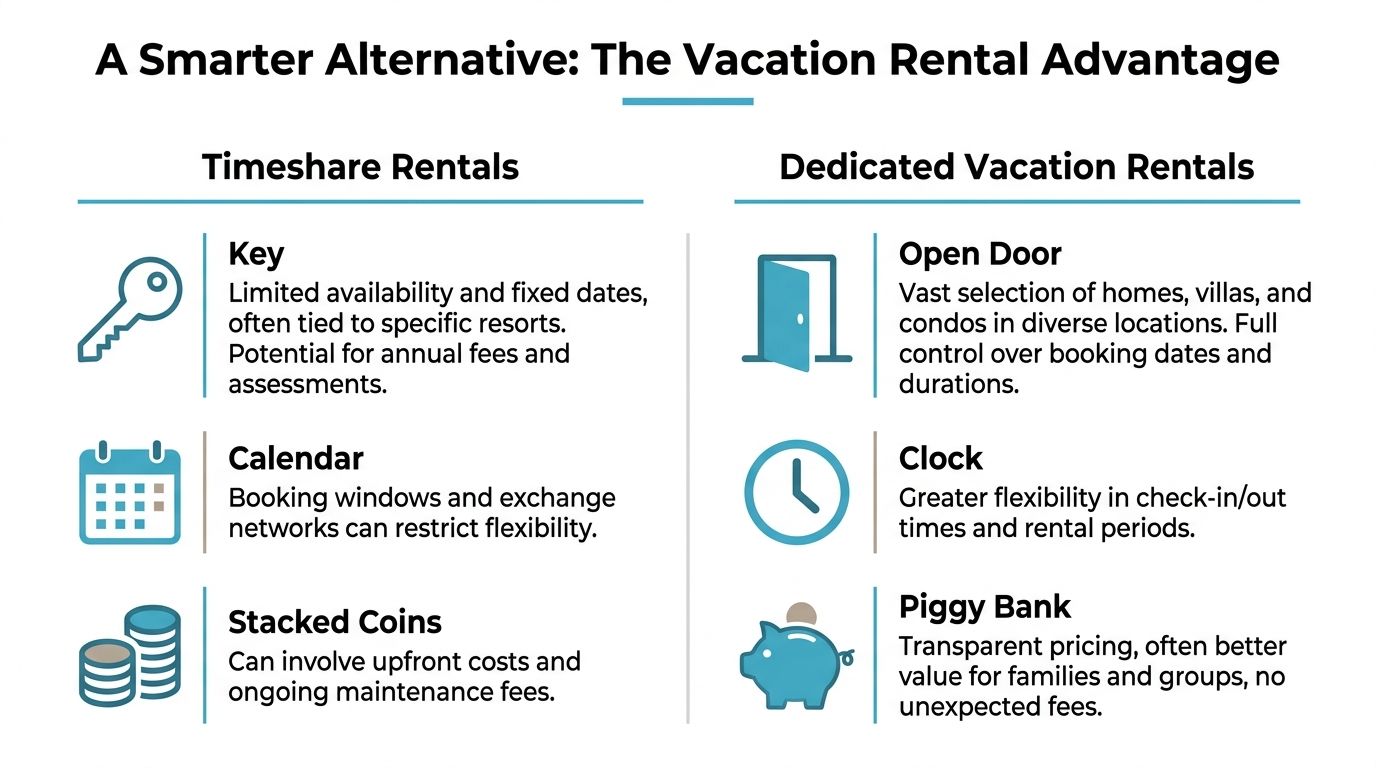
For many families, timeshare rentals solve one problem and create three more.
They solve the “we need more room than a hotel” problem. That part is real. But they can still leave you dealing with fixed dates, unit ambiguity, shared walls, check-in restrictions, and layered fees.
A dedicated vacation rental changes the equation because it is built around the trip, not around an owner’s unused resort week.
Why private homes fit Orlando trips better
A family vacation in Orlando rarely runs on a neat weekly pattern. Flights shift. Kids melt down. One part of the group wants rope drop. Another wants to sleep in. Someone needs quiet. Someone wants a late swim. Someone always needs laundry.
A private home handles that better than a resort-dependent booking.
Instead of adapting to a timeshare’s inventory structure, you choose a property that matches how your group travels. That might mean a townhome for a smaller family, or a large villa where grandparents, cousins, and siblings can all stay together without spreading across multiple hotel rooms or resort units.
The biggest difference is control
A dedicated vacation rental usually gives you more control over the details that shape the trip:
- The exact property you book
- A layout you can review in advance
- Private rather than shared living space
- A kitchen that is yours, not one shared across the resort setting
- Outdoor space that feels like part of your trip
- Stay patterns that are not tied to the logic of timeshare ownership
That matters even more when your group includes toddlers, teens, or relatives with different sleep schedules.
The fee issue is not small
Booking channel matters. A lot.
Booking directly with a property manager can save families 15% to 20% in service fees that third-party platforms charge, and for a week-long stay in Orlando that can mean $200 to $500 or more, based on this rental-market comparison summary.
That is one of the clearest financial arguments for private vacation rentals booked direct. You are not just comparing a timeshare against a house. You are comparing all-in cost structures.
What works especially well for families
Timeshare resorts lean on shared amenities. Vacation homes can deliver amenities that belong only to your group.
That changes the feel of the trip.
Better downtime
A private screened pool, game room, movie room, or themed bedroom gives kids an attraction at home base. Parents get a reset point that does not involve packing everyone up for another shared resort area.
Easier group logistics
When one person wants coffee at sunrise and another wants a midday nap, a house absorbs that better. Separate bedrooms and common space help everyone coexist without feeling crowded.
More practical food planning
A full kitchen matters in Orlando. It is not glamorous, but it is useful. Breakfast before park entry, snacks packed for the day, and a simple dinner after fireworks can save money and reduce stress.
Where timeshares still win, and where they do not
To keep this honest, there are trips where a timeshare rental still makes sense.
If you want a resort-heavy experience, love on-site activity programming, and your dates fit a standard reservation window, a good timeshare rental can work. Some travelers want exactly that.
But for many families, the vacation home is a cleaner fit.
| Decision point | Timeshare rental | Dedicated vacation rental |
|---|---|---|
| Exact property confidence | Often limited | Usually stronger |
| Privacy | Shared-resort environment | More private |
| Flexibility | Often narrower | Usually wider |
| Pet potential | Often weak | Better chance of fit |
| Fee transparency | Can be layered | Often easier to read |
| Family gathering space | Good | Usually better |
If your priority is resort atmosphere, a timeshare can be enough. If your priority is how your family lives during the trip, a private vacation home usually wins.
That is why so many returning Orlando travelers move away from timeshares after one or two stays. They realize the true luxury is not a lobby or a branded pool complex. It is having room, privacy, and a booking that makes sense from the start.
Finding Your Perfect Orlando Home Away From Home
Timeshare rentals sit in an interesting middle lane. They can offer more space than a hotel and access to strong resort amenities. For the right traveler, with the right dates, that can be a workable choice.
But the weak points are hard to ignore once you know where to look. Fixed patterns. Unclear unit details. Added fees. Pet limitations. A booking structure that often serves the ownership system before it serves the guest.
That is why many families searching for timeshares rentals in Orlando end up choosing a vacation home instead.
A private rental gives you a clearer picture of what you are booking and how the stay will function. You can judge the bedrooms, living space, kitchen, pool area, and style of the home before you commit. If you are comparing listings, strong photos matter more than people realize. This guide to high-converting home interior pictures is a useful reminder of what good listing photography should reveal and what vague imagery often hides.
The better Orlando stay is the one that supports the trip you are taking. Families with young kids need recovery space. Large groups need shared common areas. Pet owners need clear rules. Grandparents need convenience, not surprise logistics at the front desk.
That is what “home away from home” should mean. Not just more square footage, but fewer compromises.
If you have been weighing resorts against homes, use one final question: do you want to fit your vacation into someone else’s reservation structure, or do you want a place built for your group’s schedule?
The second option is usually the calmer one.
If you want a simpler Orlando stay with more space, clearer booking terms, and the option to book direct, browse Global Vacation Rentals and compare private homes, townhomes, and condos near the parks with the kind of layout families can use.